Serving Fontana, CA and surrounding areas.(909) 697-3243
Fontana Concrete Pro

Concrete Saw Cutting and Coring in Fontana, CA, Without Losing the Floor

Fontana Concrete Pro removes concrete by the line rather than by the load: a joint grid sawn into an old bay, a strip lifted for a drain, a cored hole, an opening squared for a frame.

Google reviewsFacebook reviewsBetter Business Bureau reviews5.0 Stars Rated by our customers · Google, Facebook and the BBB
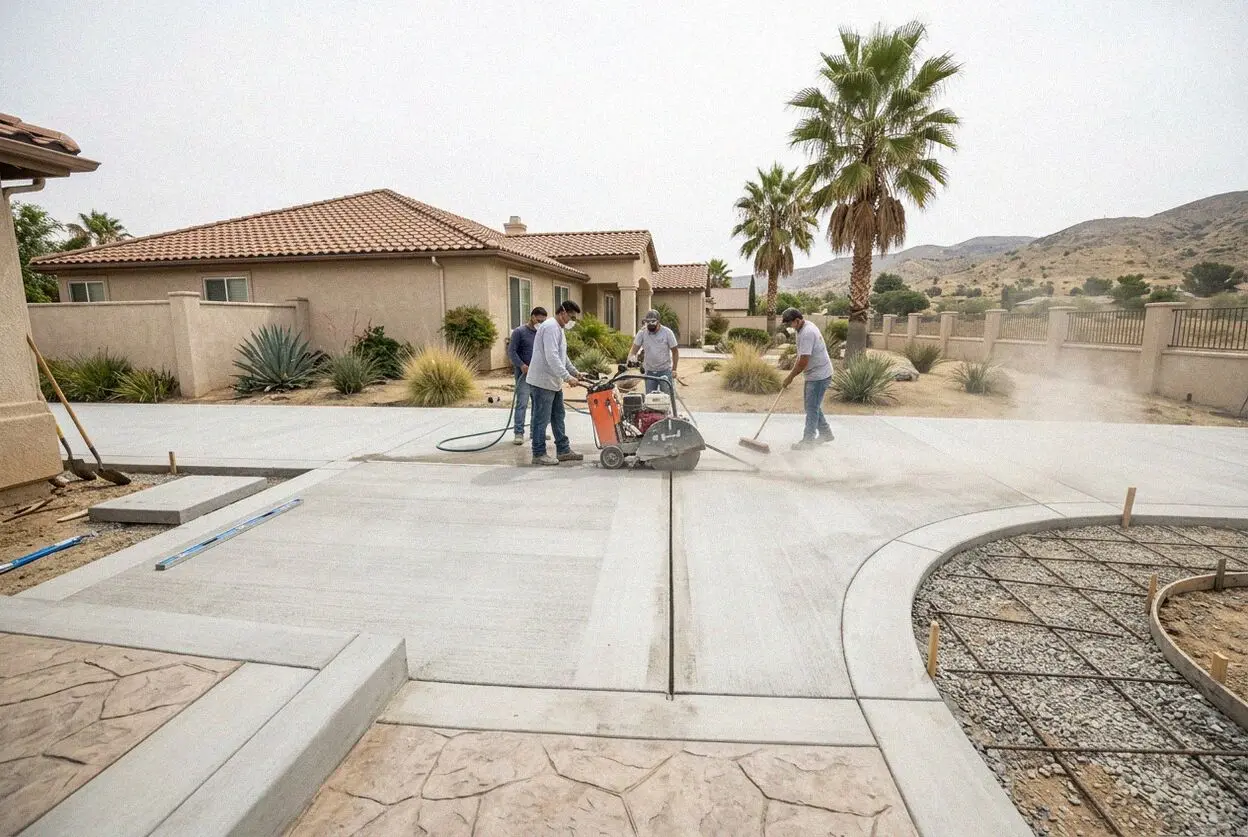
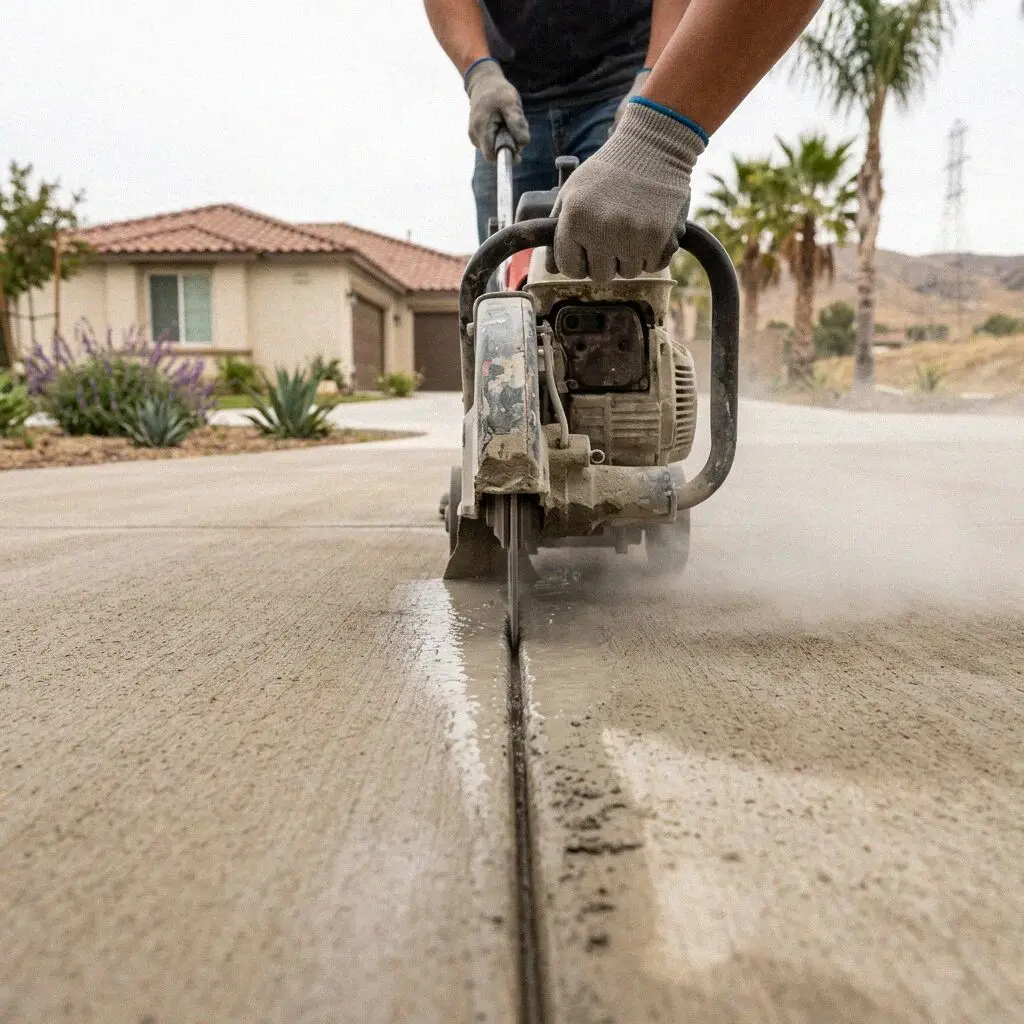
Wet saw following a chalked line on a concrete floor in Fontana
A cored opening for a drain line in a Fontana concrete floor

Taking concrete away

How a Fontana Cut Is Set Out Before Any Blade Turns

Cutting gets bought when the concrete itself is not the problem. A floor is sound but has no joints in it. A wall is sound but has no doorway. A slab is sound but a drain has to cross beneath it. Each case wants one line through something that has to go on working afterward, and that line carries all of the risk: it can run into a live water feed, a conduit or a stressed strand, none of which the surface owns up to. The reading takes the morning and the sawing takes the hour.

The calls divide three ways here. A unit on the industrial frontage wants bollards set across a roll-up door, power trenched over to a charging bay or a core through a dock apron, on concrete that is loaded again by morning. A house on the older streets is moving a bathroom or a laundry, which is one strip out of a floor that is otherwise fine. And a wide bay in the north tracts has split because nobody sawed it, and needs a grid before the next split picks itself.

The saws are run by a CSLB C-8 licensed crew carrying liability insurance on every job, on a business Andre Whitfield has run since 2019. Whether a cut is anyone's business but yours turns on what the concrete is holding, and no exempt list in this city mentions cutting at all, so Building and Safety hears about yours before a date is held for it. Every opening we make carries a written workmanship guarantee against defects in how it was built.


Saw or breaker

When Is a Blade the Answer, and When Is It Not?

A sound floor nobody sawed

A slab laid as one big rectangle shrinks anyway, and with no line to follow it takes the shortest route it can find. While the concrete is flat and unbroken that decision can be taken back: a grid sawn to a quarter of the depth hands the movement a line it has to use.

Something has to pass beneath

A relocated shower, a new floor drain, a feed out to a workshop at the back: each has to travel underneath concrete that is staying. Sawing two lines and lifting the strip between them holds the damage to that width, while a breaker sends fractures into panels nobody meant to touch.

A bay becoming a room

Garages here turn into offices, workshops and second units, and the moment one gets a bathroom the slab has to be opened for waste and vent. That is a scan, a strip and a closing pour rather than a new floor, and where it goes through the stem wall an engineer sizes the load over it.

When breaking out is honest

A saw is the wrong tool for concrete with nothing left to save. Where a slab is thin, dropped into a soft seam or cracked through in several directions, cutting a neat line into it only spends money tidying something that is coming out anyway. We price the demolition instead.

What's included

What Comes With Every Fontana Cut

Eight things on every job, inside the figure rather than added to it afterward. Each one is here because the concrete is still in use: something rests on it, steel and live services run through it, and it has to be worth having when we leave.

The line read first

Rebar, conduit and stressed strand are all read out of the line before any chalk lands on it, and the mark moves where the reading earns it.

Blade sized to depth

Thickness is measured before a machine is picked, because a blade only sinks so far and the wrong saw turns one job into two.

Slurry drummed off

Cutting water comes back caustic and full of fines, so it is lifted as it appears, drummed and carted off. No drain, no gutter.

Any grid drawn first

Where joints are being retrofitted, the panel layout is drawn and agreed on paper before a saw is fueled, not paced out on the day.

Load carried first

Where the opening takes something that is bearing, props go under it before the first pass and come out after the header.

Pieces cut to lift

Sections are sized to be slung or carried out, because a dropped piece does its damage to the slab that catches it.

The opening closed

Backfilled in compacted lifts and doweled into the sawn faces, or left swept and square for the trade that follows us.

Your options

Four Ways to Get a Line Under a Fontana Floor

Most people ring having already decided the floor has to be opened. Often it does, but three of these four leave more of it alone than the caller expected, and the cheapest row on any given job is the one that suits where the fitting actually has to end up.

OptionWhat it opensWhat stays wholeBack in useRules it out
Sawn trench and repourA strip about 24 in wide, full depth, any lengthEvery panel either side of the two linesWalked on in two days, driven at sevenThe line only crosses, and does not run
Cored straight throughOne round hole, 1 to 24 in acrossThe whole floor bar the width of the bitThe same day, once the sleeve is groutedThe pipe has to travel under the slab
In through the stem wallA cored sleeve below floor level, from outsideThe floor slab entirely, joints includedNo part of the floor goes out of useThe fitting sits well inside the building
Kept above the slabNothing at all, the concrete is not touchedAll of it, the finish includedThere is no downtime to plan aroundIt is a gravity drain and has to fall

Which row you are on is settled by the fall on a gravity drain more than by anything else. A pipe that has to run downhill under the slab cannot be routed around it.

Cutting crew working on a warehouse floor in Fontana, saw running wet

Local knowledge

In Fontana, What Decides a Cut Is Underneath It

Sawing is the short half of a job here. What the blade breaks through into, and what has to go back in afterward, is where a Fontana cut is won or lost.

The ground below these slabs came down off the mountains as sand, gravel and rounded cobble, and nothing in it binds to anything else. That is a virtue under a slab and a nuisance inside a trench: cut a strip out and the material at the edges runs, so the face just sawed loses its support from underneath while the pipe goes in. The strip is kept narrow for that reason and closed the same week. Shoveled back loose it settles, and the patch drops below the floor in a season.

The other thing that decides a cut is the decade the concrete went down. On the tracts north of the 210 the slabs date from the 1990s onward, the window in which stressed strand stopped being unusual under tract housing, so nothing is marked there until the tendons are painted on. Strand is stressed once the concrete has hardened and locked off at the edges, so a blade into one makes no hole, it lets go the length of the run. Where the scan leaves no room, the opening cannot be had.

Our process

What Happens Between the Scan and the Repour

Five stages, one crew, one written figure, and no date held until the paperwork question has been settled. Reading the slab belongs to the estimate visit, because that is while an unwelcome answer can still be designed around cheaply.

1

Measured and read

Andre Whitfield gauges the depth, runs the scanner along it for bar, conduit and strand, and marks the opening full size for you.

2

The counter question

We say plainly which counter yours belongs to, and where a drawing and a filing are needed they are ours to do before a date is held.

3

Props, sheet and hose

Props under anything bearing, sheeting over the route in and every floor drain along it, then the hose and the vacuum are set and proved.

4

Sawn wet and lifted

The blade follows the paint under water, in sections sized to come out on straps, and the slurry is lifted behind the machine as it forms.

5

Closed and handed back

Backfill compacted in lifts and the closing pour doweled in, or the opening left square and swept, and the guarantee goes into your hand there.

What moves the figure

What a Fontana Cutting Estimate Is Built From

Three measurements and one constraint: how far the line runs, how deep it has to go, what is buried in that depth, and how much has to be protected around it while the saw is running. Floor area barely comes into it.

Depth, and what fills it

Four inches of house slab goes in one pass. Double the thickness, with a mat of bar in it, and that same foot of line becomes several slow ones.

Whether anything leans on it

Where a cut takes weight off something, the figure carries a stamped drawing, props and an inspection. A floor holding itself up carries none.

What has to go back

An opening left clean for another trade is the short version. Backfill in lifts, dowels and a closing pour is a second day and a cure.

The hours you can give us

A house is cut in daylight. Where a unit can only stop between shifts, sheeting goes up and comes down inside one night, and that is what it adds.

None of this can be judged from a photograph, which shows neither depth nor steel. The visit and the scan are free, and someone rings back within 1 business day. (909) 697-3243 or send us a message.

Have the Line Scanned and Priced in Fontana

The scan is the visit and the visit is free. Call or send the form, somebody answers within 1 business day, and Andre Whitfield comes out to measure the thickness, read the line and paint the opening at full size. The figure is written before he leaves.

Request a Free Estimate

Written on site · No obligation

By submitting, you agree to our disclosure and consent terms, including being contacted by Fontana Concrete Pro.

Reviews

Cuts This Crew Has Made Around Fontana

One review for each kind of call: a grid put into a bay that never had one, a strip lifted out for a waste line, and bollards cored in at a roll-up door. In none of the three did the concrete come out.

Google review

“I rang up wanting the garage slab replaced and got talked out of it. Andre checked the floor was flat and unbroken first, then spent an afternoon putting a grid of lines across it and sealing them. Two summers on and the concrete is doing nothing at all, which is what I was paying for.”

Ivan R. of SouthridgeRetrofit joint grid · Google · 2026
Facebook review

“The plumber said the laundry waste had to cross the slab and I assumed the whole floor was coming up. They scanned it, shifted the line eight inches to miss a water pipe, and took out a strip about two feet wide. Pipe in, strip repoured, tile back down a fortnight later.”

Priscilla A., FontanaSlab strip for a waste line · Facebook · 2026
BBB review

“We kept getting the roll-up door frame clipped, so we wanted six bollards across the front of it. They cored the holes rather than breaking them, which meant the apron around each one is untouched, and set them the same day. Trucks were tipping again the next morning.”

Wendell T., FontanaCored bollard holes at a dock · BBB · 2025

FAQ

Cutting Questions Fontana Owners Ask

What can be opened up while the rest stays where it is, what has to be drawn and filed before anybody starts, where the water and the dust go, and how soon a floor is usable again.

(909) 697-3243
  • Is sawing joints into my garage floor cheaper than replacing it?

    Yes, where the floor is still flat and unbroken, and worth asking before you accept a price for a new bay. The lines go to a quarter of the slab's depth, which is what the Portland Cement Association publishes, and no panel is left wider than about 12 feet on a four-inch floor. Sawing does not undo cracking that has happened. It takes charge of where the rest goes, which is all a sound garage floor needs.

  • What is under a Fontana slab once the strip comes out?

    Sand, gravel and rounded cobble, in almost every case, because this whole city sits on what the creeks brought down off the mountains. It drains freely and it does not hold a vertical face, so an open trench sheds material from under the sawn edge if it is left standing. That is why the strip is narrow, why it is closed quickly, and why the backfill goes in compacted in lifts rather than shoveled back in one go.

  • Do I need a permit to cut into concrete in Fontana?

    What the concrete holds up decides it, and there are two counters. A doorway cut into a foundation, or into any wall carrying the house, is building work every time: an engineer draws it, it is filed on the Build Fontana portal and an inspector sees the props. A saw put to the public sidewalk or the curb is Engineering's, under an encroachment permit. A grid in your own floor is on no exempt list, so we ask.

  • How do you know whether my slab is post-tensioned?

    It gets scanned, and on the newer tracts that is assumed until the reading says otherwise. Stressed strand became normal under California tract housing from the 1990s on, and a floor built that way is held together by greased cable under tension from edge to edge, so a blade into one lets the whole run go rather than leaving a hole. The lines are painted on the surface and the opening is placed between them.

  • Is there a depth beyond which a saw cannot reach?

    There is, and it is the geometry of a round blade: one sinks a little under half of its diameter into the work. That is about 12 inches from a walk-behind machine, and about 24 inches from a wall saw running on rails. Thicker than that and the wall is cut from both sides, so somebody has to be able to get at the other one. A core bit sets all of it aside: an inch to two feet across, and as deep as the hole needs.

  • Where do the dust and the water from cutting end up?

    The dust is never allowed to become dust. Water arrives at the diamond, so the fines leave the cut already wet, and that feed is the control Cal/OSHA names for saws and core drills, which is why no blade of ours runs dry indoors. What comes off the floor afterward is alkaline enough to set solid in a trap, so it is vacuumed up behind the machine and drummed, and the drums leave on the truck with the spoil.

  • What happens to the concrete you take out of the floor?

    It goes on the truck the same day and to a crusher, not into your yard or a skip you have to deal with. A sawn strip comes out in lengths a two-man lift can manage, cores come out as solid cylinders and both are clean material, which is the reason it can be recycled as base rock rather than buried. The area is swept and washed down before we leave, so the next trade is not working around our spoil.

  • How soon can we use the floor after a strip is repoured?

    The patch takes foot traffic inside two days, a car after seven and anything heavy at 28, because concrete goes on gaining strength for the whole month. Sawn joints have nothing to wait for at all, since nothing was poured into them. Where a floor cannot be lost for a week, the open strip is plated over and the closing pour booked for a night that suits the building.

Service area

Cutting and Coring Beyond the Fontana City Line

Every town below sits inside the radius these saws work to, listed by its distance from the Sierra Avenue office. A night shift inside a working unit is arranged wherever the building happens to stand.

Show All Areas We Serve

Book a scan for your Fontana cut

Say what has to get through the concrete and somebody comes out to look at it, within 1 business day. Thickness measured, line read, opening painted at full size, and a straight answer on whether an engineer has to draw it first.